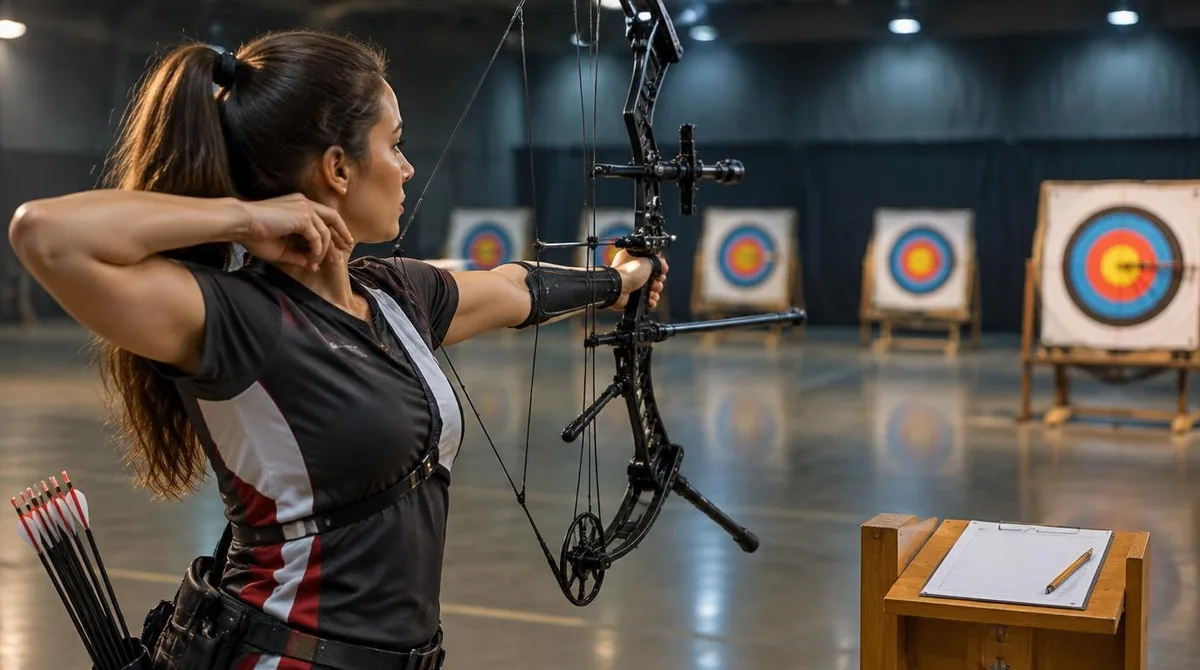
Target archery is the scored side of the sport: fixed distances, multi-ring faces, and a card that records every mistake. Indoors it runs 18 meters; outdoors, World Archery sets recurve at 70 meters on a 122 cm face and compound at 50 meters. Bowhunters treat it as the gym. The summer league builds the shot routine that holds together when a buck stands at twelve yards and the release has to happen now.
The value is honesty. A scored face forgives nothing, and it reports exactly what the front hand, the anchor and the release did on each arrow. Formats differ, but the scoring backbone stays the same from club night to world final. For related coverage, see Best Rifle for Deer Hunting: Action, Weight and Cartridge Fit.
Target Archery Formats
Indoor rounds dominate the winter. World Archery's indoor standard runs 18 meters, with compound archers shooting 40 cm faces and recurve archers 60 cm faces, and USA Archery just held its 58th Indoor Nationals on that pattern. Outdoor rounds run the ranking format made famous at the Olympics: 72 arrows at 70 meters for recurve, 50 meters for compound, with 720 as the perfect score.
Clubs fill the calendar around the majors: 300-round league nights, five dozen arrows on a single face, and field rounds that walk a course through the woods. The formats share one spine, which is scored ends at fixed distances under a clock.
How Scoring Works
The standard face scores ten zones, ten points in the gold center down to one point at the outer white edge. An inner X ring breaks ties at the top, and compound divisions shoot a smaller inner ten, which tightens the game at the top end. Ends run three or six arrows, and scores go on the card before anyone pulls.
Scoring discipline is its own training. Calling each arrow honestly, adding in pairs, and watching for the pulled-line judgment calls teaches the same calm a hunter needs when counting tines. Archers who score every arrow learn their true average, which is the number that matters.
From Ranking Rounds to Set Matches
World Archery's match play gives the sport its drama. The 72-arrow ranking round seeds a bracket, then matches run in three-arrow sets: two points for winning a set, one for a tie, first to six points advances. Ties go to a single-arrow shoot-off, closest to the center. Team and mixed-team events run the same logic in faster gears.
The set system rewards steadiness over fireworks. A shooter who trades tens for nines under pressure wins more matches than one who chases golds and drops sevens. This connects to our earlier piece, Hunting Gear for a Full Season: The Layering System That Holds Up.
How Hunters Use Target Archery
League night is the cheapest instruction in archery. Shooting beside strangers, on a clock, with a card to sign, rehearses exactly the pressure that buck at the standoff applies. Hunters who shoot one winter league routinely report calmer releases the next season.
The work carries over in specifics: a repeatable anchor, a aiming picture that does not change, and a follow-through held until the arrow lands. The winter card proves all three, week after week, before a single leaf falls.
Conclusion: Score the Practice
Target archery hands a bowhunter the three things a range bag cannot: formats that mirror pressure, scoring that reports the truth, and a season of reps that end in a number. Pick the nearest club, shoot the winter league, and let the card do the coaching. November shows the difference.