How do you kill a deer on ground that anyone with a license can hunt? The short answer: you out-plan the crowd, not the deer. Public-land success comes from weeks of desk work before the season, a clear-eyed read of where other hunters will go, and the discipline to walk past the easy spots.
This guide walks through the planning sequence for a do-it-yourself public-land deer hunt. It covers how to research access, how to read hunting pressure, and how to build a plan that survives contact with a full parking lot. The word itself has old roots. The word "public" comes from the Latin publicus, meaning "of the people," as Simple English Wikipedia explains in its entry on the term — and that is exactly what you are dealing with: land of the people, shared with every other license holder in the state.
That shared ownership is the whole game. It shapes where deer bed, where hunters walk, and where your odds actually sit. Plan for the people first, and the deer plan takes care of itself.
What does access research look like before you ever leave home?
Start with the land ownership map, not the hunting app's hot-spot layer. State wildlife agency websites publish game-area boundaries, and county GIS or parcel viewers show who owns the private ground that borders it. A big public tract hemmed in by posted private land has few entry points, and every one of them gets traffic. A tract with scattered public parcels and open farm-field edges spreads hunters out. For related coverage, see Target Archery Formats, Scoring and How Hunters Use Them.
Check the regulations for the specific unit while you are at it. Season dates, weapon restrictions, antler rules and check-in requirements all vary by unit, and some areas require a draw permit or a reservation for certain days. The agency that manages the land publishes these rules; read them directly rather than trusting a forum summary. Note the access rules too. Some walk-in areas ban motorized travel, some close parts of the season, and some post special rules at the gate that never make it onto the general map.
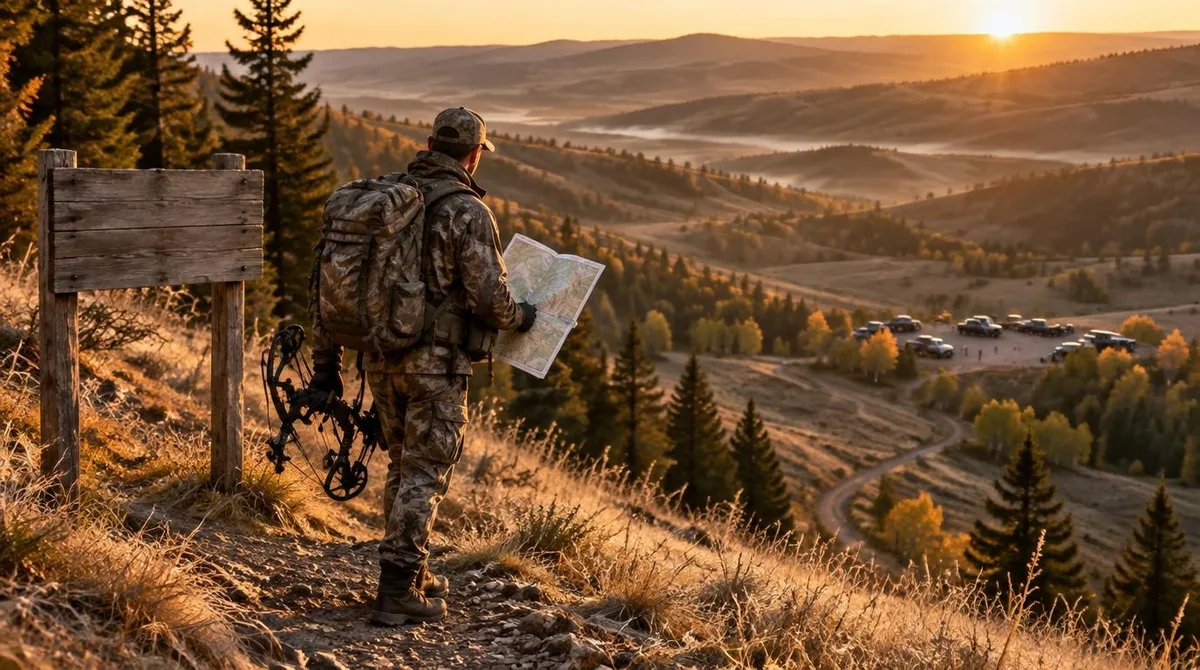
Then look at the ground itself. Aerial imagery and topographic maps tell you where the funnels, ridges and creek bottoms are. Cross-reference that with what you know about deer behavior in that region: where the food is, where the security cover sits, and where the two connect. A mapping session that produces three or four candidate stand areas, each with a distinct walk-in route, is worth more than any gear purchase.
How do you read and beat hunting pressure?
Pressure is the single biggest difference between public and private ground. On private land, a hunter controls disturbance. On public land, disturbance is a weather system: predictable in kind, variable in strength. Most hunters park at the easiest trailhead, walk the path of least resistance, and settle within a few hundred yards of the road. You can watch this pattern repeat on almost any popular tract, opening weekend especially.
The beat is simple in principle. Go where the crowd does not. That usually means a longer walk, a worse approach, or nastier terrain — a swamp edge, a steep north slope, a tangle of downed timber a half-mile past where the trail dies. Deer on pressured ground shift their patterns toward exactly these refuges, bedding closer to the hard-to-reach cover and moving mostly in low light.
Timing matters as much as place. Opening day and the first weekend draw the maximum crowd. Midweek hunts, late-season dates and poor-weather days see far less company, and deer that have been pushed around all season use those lulls to move. If your schedule allows only one trip, consider skipping the opener and hunting a quieter stretch instead. An unpressured Tuesday in November often beats a crowded Saturday.
One caution from the field-editor's notebook: pressure tactics cut both ways. Pushing deep into cover on foot every scouting trip teaches the deer the same lesson the crowd does. Scout hard in the off-season, then hunt quietly and enter and exit with the wind and the dark on your side.
What should a realistic trip plan include?
Build the plan in layers, and write it down.
- Unit and dates. Confirm the season dates, tag requirements and any draw deadlines for the specific unit. Apply early where draws exist, and have a second-choice unit in mind.
- Access map. Mark every legal entry point, then mark the ones you actually intend to use — including a backup approach in case your primary route has company.
- Stand locations. Three or four spots per day, ranked by wind direction. Wind decides which one you hunt, not preference.
- Logistics. Camping or lodging, the nearest town for fuel and food, cell coverage gaps, and the location of the nearest game-check or electronic check-in option.
- Exit plan. How you get out without spooking everything you walked past. On pressured ground, a bad exit costs you the next morning.
Physical preparation belongs in the plan too. Public-land bowhunting usually means packing gear farther than you would from a truck, and often dragging a deer farther back. Practice with the pack weight you will carry, and shoot your broadheads at realistic distances before the trip. Off-season range work pays off here; our Archery Games for the Range That Sharpen Off-Season Shooting piece covers ways to keep that practice honest.
What this means for your first public-land trip
Our analysis of what separates successful do-it-yourself hunters from frustrated ones comes down to expectation management. Public land will not hand you a mature deer on a schedule. What it offers is real opportunity, on ground that belongs to everyone, to the hunter willing to do the unglamorous work: reading parcel maps, walking farther, hunting worse weather and stranger hours. Treat the crowd as part of the habitat. Learn its habits the way you learn the deer's, and hunt the gaps between the two.
Start smaller than you think you need to. A tract within day-trip range that you can scout repeatedly teaches you more than a dream unit two states away that you will see once. Learn the pressure patterns on familiar ground first, then take the same method on the road. When you are ready to widen the search, our Hunting Destinations coverage and the broader Hunting Travel section both follow this same planning-first approach to hunts far from home.
The field note
Before you go, do one last check the night before the hunt: re-read the unit's posted rules, re-check the weather and wind forecast, and re-walk your entry route in the dark if you can. The hunters who fill tags on crowded public ground are rarely the ones with the best gear. They are the ones who know exactly where they will park, which way the wind must blow, and how they will get out — decided long before daylight.