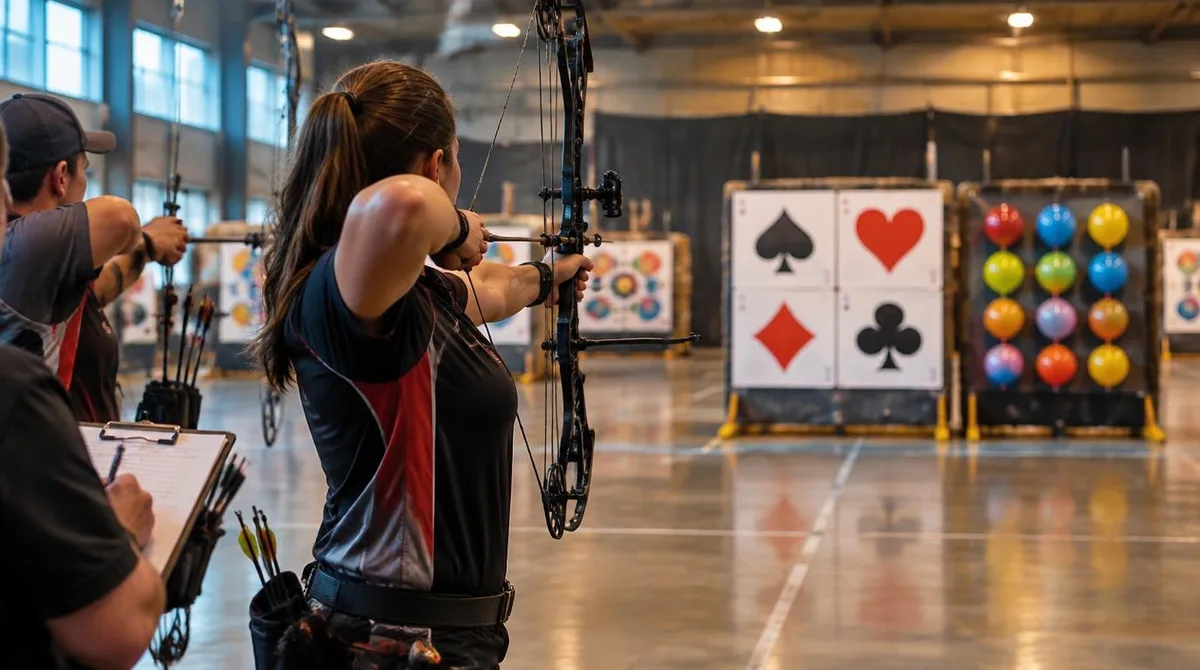
Archery games are the off-season's best tool. Balloon ladders, playing-card poker, tic-tac-toe faces and timed ends turn plain practice into stakes, and stakes build shooters. An archer who has shot for a queen of hearts at 35 yards in front of a laughing club does not rattle when a buck steps out at eighteen. Clubs have run novelty shoots on that exact idea for generations, because it works.
The mechanism is simple. Games attach a price to each shot and a crowd to each score, which is precisely the pressure a hunter faces in November. Fun is not the opposite of training; it is the delivery system. Stakes build shooters the same way a scoreboard does. The best archery games scale to any skill level, which keeps whole families shooting together. Readers following this should also see Target Archery Formats, Scoring and How Hunters Use Them.
Why Archery Games Beat Blank-Bale Reps
Blank-bale work teaches form, and it gets boring by July. Archery games keep the brain in the shot, because every arrow decides something. Variety also exposes weak spots that fixed-distance practice hides, like first-arrow nerves and the aim decay that shows up late in a round. Laughter is a legitimate training tool. This connects to our earlier piece, Olympic Archery Equipment Rules, Format and Scoring Demands.
Attendance tells the story at any club. Game nights fill lanes that sit empty during open practice, and archers who play through summer arrive at fall leagues and hunting seasons with hundreds of extra logged arrows.
Games also build the shooting memory hunters lean on. A timed end teaches what a hurried shot feels like, so the feeling stops being new in November. The queen of hearts round teaches aim small under an audience. Each game files a lesson that plain repetition never writes. Nerves, aim and clock sense all get reps.
Games That Sharpen Shooting
- Balloon ladder: five balloons from near to far. Miss one and the round stops, which trains recovery after a bad arrow.
- Playing-card poker: five cards on a backstop, best poker hand wins. Small targets at honest distances build pinpoint aim.
- Tic-tac-toe: a nine-square face shot in alternating turns. Every arrow has consequences, just like a match.
- Shrinking dots: start on a six-inch spot, step down an inch each end. Ends when a shot misses the ring.
- Timed ends: three arrows against a clock at league pace. Speed with a clean release is the whole skill.
- Nerve: one arrow at the smallest dot for the round's whole score.
- Partner best-ball: two archers, one score, real teamwork.
Setting Games Up at Home
The set-up is the same as any safe range: a rated backstop sized for the bow, field points for foam, and a clear zone behind everything. Morrell bag targets handle high-volume field-point shooting with replaceable faces, and Rinehart's self-healing foam animals turn any game into 3D practice with vital rings to aim at.
Keep score on paper, even for silly games. A written number turns a July evening into a progress record, and end-of-summer totals tell a hunter which distances still need work before the season.
Distances should ladder upward across the summer. Start each session at ten yards to confirm form, then step back in five-yard jumps until the groups open. Good archery games played at the far edge of honest range teach more than games played safe.
Club Shoots, Leagues and Programs
The club scene multiplies the fun. USA Archery lists clubs by region, most of which run fun shoots, 3D events or weekly league nights, and its JOAD programs wrap games and pins into youth instruction. The governing body even runs virtual tournaments now, so a home range can join a national field without travel.
For bowhunters, the 3D course is the big game night: unmarked yardage, foam animals and a walk in the woods with a scorecard. Between club shoots, a deck of cards and a bag of balloons keeps a home range busy all summer. Charity fun shoots and league banquets round out the calendar, and most clubs welcome guests for a small fee. USA Archery's event calendar lists 3D shoots and fun shoots by state.
Beyond formal rounds, many clubs schedule informal games that quietly build the same skills. A common format asks each archer to shoot a full round at a single spot, then at shrinking faces, which rewards a repeatable anchor under mild pressure. Another keeps a running tally across a winter league, so one weak end matters across weeks rather than one afternoon. The value of these formats lies in volume with intent: dozens of scored arrows per session, each with a clear standard to meet, and a scorebook that shows whether form holds when the score is close. Archers who track league scores across a season often see group size tighten before the average rises, which is the expected order.
Conclusion: Play the Way Into Fall
Archery games earn their lane time. They build pressure-proof releases, honest distance judgment and a logged body of shots, all disguised as fun. Stock a few balloons and a deck of cards, find the nearest club night, and let the games do the coaching until opening day. The games cost almost nothing and return steady hands in trade.