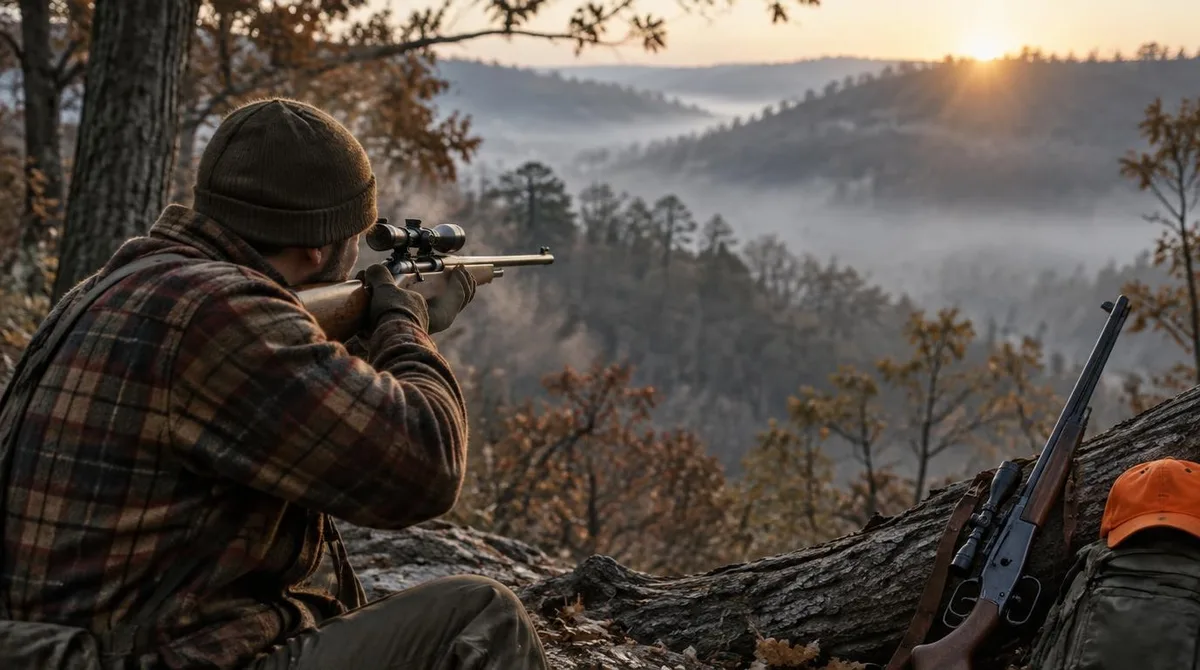
Most deer hunters carry a bolt action, a lever action or a semi-automatic, and the honest answer to "which is best" is the one that fits you and points where you look. MeatEater puts it plainly: the best deer hunting rifle is the rifle you already own, because almost any rifle chambered in a deer-appropriate cartridge will do the job inside the distances where most whitetails are shot.
The real decision is narrower than the catalog suggests. Pick an action that suits your cover and your shooting style, pick a cartridge that is easy to shoot well, and pick a weight you can carry all morning. Get those three right and the price tag matters less than the fit.
What the Three C's Mean Before You Shop
MeatEater's rifle guide boils the choice down to three C's: comfort, cartridge and cost. Comfort covers how the rifle carries and how it shoots. An adjustable stock helps the gun conform to your body and get you a clean sight picture fast. A light trigger with a crisp break matters too, because most misses come from a small jerk at the moment of the squeeze.
Cartridge is the second C. MeatEater's short list of deer-appropriate rounds includes the .243 Winchester, .30-30 Winchester, .308 Winchester, 6.5 Creedmoor, .270 Winchester, 7mm-08 Remington and .30-06 Springfield. Mid-power cartridges are easier to shoot, cheaper to feed and fully capable on the biggest buck in the woods. For a deeper dive on the ballistics side, see our Best Deer Hunting Caliber Picks Ranked by Ballistics and Law.
Cost is the third C, and it is the most forgiving. A bargain rifle that you have learned well beats a premium rifle you shoot twice a year.
Bolt Actions, Levers and Semi-Autos in the Deer Woods
The bolt action dominates for a reason. It is accurate, simple and available at every price. The North American Whitetail roundup of the best deer rifles ever made is stacked with bolts: the Winchester Model 70 with its controlled-round feed and three-position safety, the Remington Model 700, and the military-derived M1903 Springfield that set the standard for big-game rifles in .30-06.
Lever actions still own the tight timber. The Winchester Model 94 was the first rifle chambered for the .30-30, and that pairing has been a favorite of deer hunters for generations. North American Whitetail credits the 94 with being light, quick to point and perfect for close cover. The Marlin 336, introduced in 1948, answered with a flat-top receiver and side ejection that made scoping easier, and Hornady's LeveRevolution ammo let hunters load pointed bullets in tubular magazines. The lever design is not stuck in the past either: American Hunter's 2025 new-rifle list includes Smith & Wesson's Model 1854, newly offered in .30-30 with a 20-inch threaded barrel and ghost-ring sights, and in .45-70 with a 16.5-inch threaded barrel for blind and timber work.
Semi-automatics round out the field. The Browning BAR, on the scene since 1967, remains a favorite because its gas system delivers fast follow-up shots with reliable accuracy. Single-shots fill a niche too. The Ruger No. 1 falling block, introduced in 1966, built a cult following on a simple idea: one shot is enough if you make it count.
How Fit and Weight Decide the Carry
Weight is where many purchases go wrong. MeatEater looks for something between 6 and 8 pounds: too heavy is hard to shoot standing or rested against a tree, and too light kicks hard in a big caliber. Barrel length matters in elevated stands and blinds, where a long barrel snags on everything; that guide's writer prefers a maximum of 22 inches, partly to leave room for a suppressor.
Fit shows up at the trigger and the stock. The Ruger American Gen II, per American Hunter, added an adjustable comb that works better with modern optics, a length-of-pull-adjustable stock and a three-position tang safety that lets you load and unload with the safety on. Those are the kinds of features that turn a rifle you tolerate into one you shoot well.
Our analysis: try the rifle mounted before you buy it. Check that your eye lines up with the scope naturally, that the bolt handle clears your hand on the cycle, and that you can work the safety without shifting your grip. None of that shows up on a spec sheet, and all of it decides whether the shot goes where you want.
What a Budget Buys at Each Price Point
The used market is the budget play. MeatEater recommends a used Savage Axis in the $0-300 range: expect workable rather than great accuracy, a mediocre original trigger, but rugged steel barrel and receiver. Thousands of these went out the door as first rifles, and many come back to market barely used.
New guns start around the $300-600 band with the Ruger American Gen II, listed at $580, with an adjustable trigger and Cerakoted metalwork. The $600-900 tier holds the Tikka T3x Lite at $770, and Outdoor Life's mid-priced rifle test named the T3x Lite best for the money in the $700-1,300 range, citing its smooth 70-degree bolt throw, crisp measured 3-pound-2-ounce trigger and 1.96-inch average five-shot group in .308 Winchester. Above that, the Bergara B-14 Timber ($980), the folding Sig Sauer Cross TRAX ($1,400) and the Christensen Arms Ridgeline ($2,000) buy lighter weight, better stocks and threaded muzzles.
Outdoor Life's testing notes carry a lesson for any shopper: three-shot groups lie, and even five-shot groups tell you less than a 20-shot composite about how a rifle actually shoots. If a shop lets you fire a demo gun, shoot it more, not less, before you judge it.
Practical Steps: Match the Rifle to Your Cover
- Open country and longer shots: a bolt action in a mid-power flat-shooting cartridge, scoped and steady.
- Thick timber and stands: a lever action in .30-30 or a short-barreled bolt, light and quick to point.
- Food plots and follow-up-heavy setups: a semi-automatic like the BAR where legal.
- Tight budget: shop the used rack first; a used Axis or a Stevens 334 near $300 will kill deer.
- Any budget: budget for a good trigger pull and proper stock fit before you budget for finish.
For how action type and cartridge interact, our Best Rifle for Deer Hunting: Action, Weight and Cartridge Fit guide walks the pairing in detail, and our firearms section tracks new releases each season. More gear coverage sits in our hunting gear hub. For related coverage, see Best Rifle for Deer Hunting: Action, Weight and Cartridge Fit.
A Field Note Before You Buy
Carry the rifle around the store, not just shouldered at the counter. If it balances where your hand naturally rests and the stock fits your length of pull, you will shoot it better than anything you read about online. And remember the first rule from MeatEater's crew: if the rifle in your safe already puts several shots on a paper plate at 100 yards, the best deer hunting rifle you can buy this year is the one you already own.